
Understand what shifts the odds at the table
 Available in US
Card values, player decisions, dealer rules and payout structures all affect how blackjack hands play out.
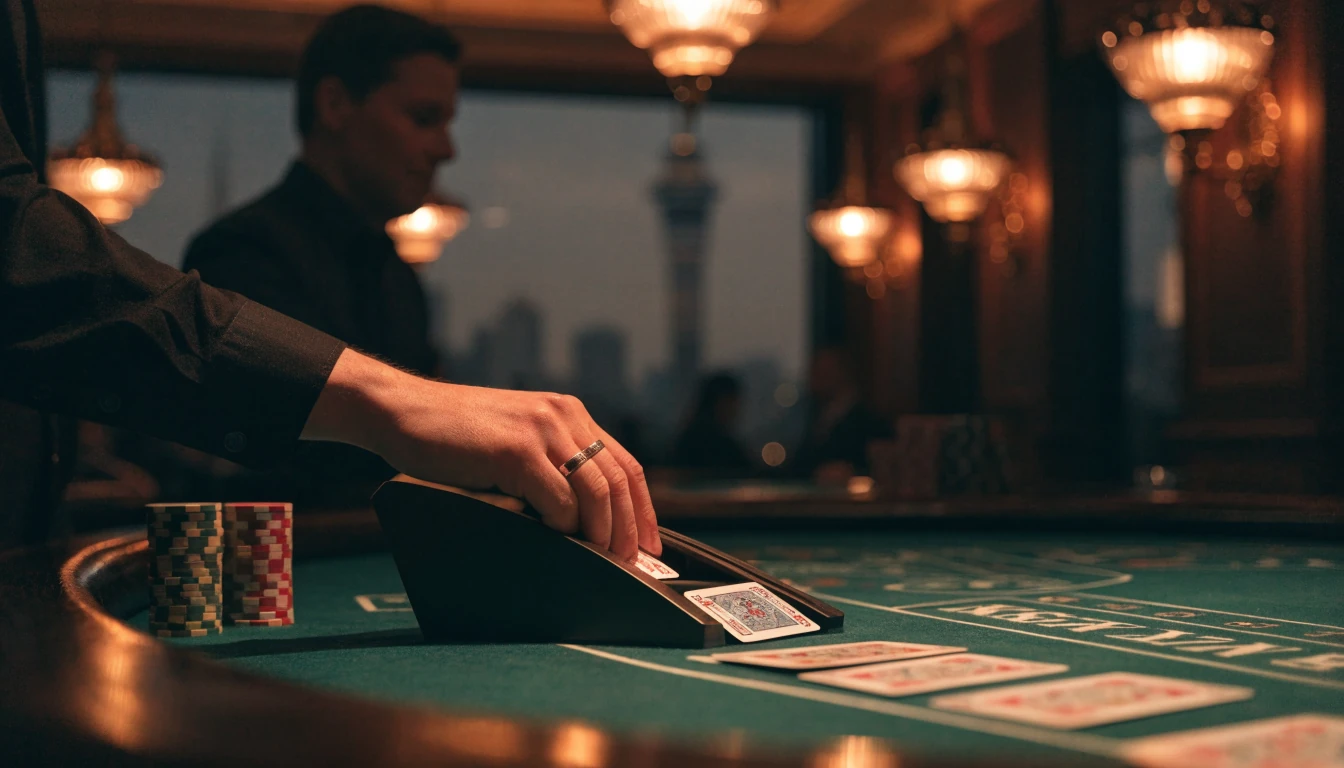
What the Cards and Decisions Mean for Blackjack Odds
Blackjack is played against the dealer, not as a contest in which you need to beat the other players at the table. Your aim is to finish with a hand closer to 21 than the dealer’s without going over 21. The cards determine your total, while your decisions determine whether you take another card or keep the hand as it stands.
Number cards count at face value, so a seven adds seven to the hand. A jack, queen or king counts as ten. An ace is flexible: it can count as either one or eleven, depending on which value helps the hand without taking it over 21. That flexibility is why two hands with the same visible card can have different totals and different options.
A hand containing an ace counted as eleven is often called a soft hand. If another card would make the total exceed 21, the ace can instead count as one. A hand without that flexibility is often called hard. These terms describe how the total works; they do not, by themselves, say what decision is best.
Blackjack odds depend on the rules and decisions involved, so choosing where to play is only one part of assessing your options. Use this list as a quick reference when considering operators for blackjack in New Zealand in 2026.
-
BitStarz
- License
- Curaçao Gaming Authority, licence no. OGL/2024/165/0185
BitStarz lists a Curaçao Gaming Authority licence, number OGL/2024/165/0185. You can use that detail as a reference when evaluating the operator.
-
Wintino
- Payout speed
- 1-3 business days
Wintino lists a payout speed of 1–3 business days. This gives you a stated timeframe to consider when assessing its payment arrangements.
-
Ricky Casino
- License
- Tobique Gaming Commission, licence no. 0000002
Ricky Casino lists a Tobique Gaming Commission licence, number 0000002. You can refer to this licensing detail when considering the operator.
-
7Bit Casino
- License
- Tobique Gaming Commission, licence no. 0000091
7Bit Casino lists a Tobique Gaming Commission licence, number 0000091. This provides a specific licensing detail for your consideration.
-
Zotabet
- License
- 07017519840
- Payout speed
- 1-3 business days
Zotabet lists licence number 07017519840 and a payout speed of 1–3 business days. These are the available details to consider when reviewing the operator.
-
N1 Casino
- License
- Malta Gaming Authority, licence no. MGA/B2C/394/2017
N1 Casino lists a Malta Gaming Authority licence, number MGA/B2C/394/2017. You can use this information as a reference when assessing the operator.
-
Neospin
- License
- Tobique Gaming Commission, licence no. 0000064
Neospin lists a Tobique Gaming Commission licence, number 0000064. This licensing detail may help inform your review.
-
Lamabet
- Payout speed
- 1-3 business days
Lamabet lists a payout speed of 1–3 business days. This stated timeframe is the available detail to consider when reviewing its payment arrangements.
-
Play Grand
- License
- Malta Gaming Authority, licence no. MGA/B2C/370/2017
Play Grand lists a Malta Gaming Authority licence, number MGA/B2C/370/2017. You can refer to this detail when considering the operator.
A two-card hand made from an ace and a ten-value card is a natural blackjack. Other combinations can also total 21, such as three cards adding to that value, but they are not the same starting hand. So a question about the odds of getting 21 can mean different things: a natural on the first two cards, or reaching 21 after taking additional cards. The distinction matters before any probability can be discussed.
The same care applies to questions about drawing a ten. Ten-value cards include the ten and the three face cards. But the chance of drawing one is not the whole story behind a hand: the cards already dealt, the cards still available and the table’s dealing setup all matter. A card’s value is a rule; it is not a complete answer about the odds of a particular result.
Once you have a hand, the available choices are hit, stand, double down and split. A hit means taking another card. Standing means keeping the current total and taking no more cards. Doubling down lets you increase the bet and take a further card under the table’s rules. Splitting is available when your starting cards form a pair: they become separate hands, each played in turn. Whether and how these options apply depends on the game’s rules.
Some tables also allow surrender, which means giving up the hand under specified conditions rather than continuing it. It is not available everywhere. These choices change what can happen next, but they do not change the meaning of the card values.
When someone asks about blackjack odds, they may mean the chance of being dealt a natural, the chance of making 21, or the chance of beating the dealer. Those are different questions. A matchup described as “11 against a dealer’s 5,” for instance, identifies two totals; it is not itself a probability or an instruction. To understand what any odds figure refers to, first identify the hand, the point in the deal and the outcome being counted. Without that context, a number can sound precise while answering the wrong question.
How Basic Strategy Changes Your Decisions
Basic strategy is a way to choose an action for the hand in front of you, rather than relying on instinct or trying to predict what the next card will be. It links your hand and the dealer’s visible card to a decision: hit, stand, double down or split. The point is consistency. You apply the same decision rule to the same situation instead of changing course because a previous hand went well or badly.
A strategy chart presents those choices in a compact form. To use one, first identify your hand, then find the dealer card shown on the chart. The point where those two meet indicates the recommended action for that situation. The chart is not a forecast of the next card, nor does it say that a particular hand is certain to win. It is a guide to choosing between the options available under the game’s rules.
Do
- Use a strategy chart to maintain consistency
- Match the chart to the specific table rules
- Follow recommendations even when counterintuitive
Don't
- Rely on instinct or predicted next cards
- Change course based on previous hand results
- Apply a universal chart to every game
The options change what you are asking the dealer to do. When you hit, you take another card and accept the risk that the hand may go over twenty-one. Standing means taking no more cards and letting the dealer’s turn determine the result. Doubling down changes the commitment on a hand while calling for another card; splitting separates a pair into separate hands when the table permits it. Each choice has a different consequence, so the same hand total can call for different actions depending on the situation.
Basic strategy helps by making those distinctions explicit. A player who always hits a particular total, for instance, is using a fixed rule that ignores the rest of the hand’s context. A chart-based decision instead accounts for the dealer card and whether the player’s hand is a pair or has an ace that can be treated flexibly. The recommendation can therefore differ even when two hands appear to have the same total.
This is why a blackjack strategy odds chart should be read as a decision aid, not as a list of the odds of every possible hand. A hand’s probability describes how likely an outcome is; a strategy recommendation tells you what action to take in a given situation. Those ideas are related, because the action can affect the prospects of the hand, but they are not interchangeable. A chart cannot tell you that your next hand will win, and a probability for a hand by itself does not select your move.
There is no single chart that can be applied blindly to every blackjack game. Table rules can differ, and strategy can depend on those rules. Before using a chart, check that it matches the game you are playing and that the actions it describes are available at that table. If a chart assumes an option the table does not allow, its recommendation may not fit your situation.
Playing basic strategy means following the applicable recommendations hand by hand, including when the recommended choice feels counterintuitive. It does not mean choosing the action that would have worked best after seeing how the cards fell. That is hindsight, not a usable plan. Nor does a strategy turn an uncertain game into a certain result. It is a disciplined way to make decisions, not a promise about what the dealer or the next card will do.
If you are comparing blackjack odds while playing with basic strategy, keep the question narrow: what decision does the strategy recommend for this hand under these rules? Do not confuse that with the chance of a particular card appearing or the chance of winning an entire session. Those are different questions, and a decision chart is built to answer the first one.
Perfect Play Does Not Remove the House Edge
“Perfect play” in blackjack means making the mathematically strongest decision available in each situation, given the rules of the game and the cards known to you. It does not mean knowing what card will appear next, nor does it make every hand a win. The phrase describes decision quality, not a special outcome or a guarantee.
That distinction matters when you look up blackjack odds with perfect play. There is no single figure that applies to every version of blackjack, because a strategy is only optimal relative to a particular set of rules. Blackjack variants can change both the decisions that make sense and the house edge. A strategy suited to one game may therefore not be the best strategy for another.
Perfect play works within the game’s boundaries. It cannot change the rules, undo a losing hand or make a future card predictable. Even when your decisions are consistently sound, the dealer can still win, and the result of an individual hand can differ from what a sound decision might suggest over repeated play. “Optimal” means choosing well with the information available, not controlling what happens next.
The house edge is the casino’s mathematical advantage under the conditions of a game. It is not a promise that the casino will win each hand or each visit. Rather, it describes an advantage built into the game’s rules over time. Good decisions can reduce the effect of avoidable mistakes, but they do not necessarily remove that underlying advantage. If the game’s rules leave the casino with an edge, perfect decisions alone do not reverse it.
This is why “what are the odds if you play perfect blackjack?” needs more context than the phrase suggests. The answer depends on which game is being played and what its rules allow. Without those details, a precise claim about the odds would be false precision. You can compare strategies only after identifying the rules they are meant to address; there is no universal perfect-play number that can be carried unchanged from one table to another.
The same caution applies to searches for “perfect pair odds” or the house edge in Blackjack Switch. Those names point to features or versions of the game, not to one shared set of conditions. A label does not tell you enough to establish a numerical advantage or the correct strategy. The relevant question is what rules govern that particular game and whether the strategy being discussed was worked out for those rules. A number detached from its game conditions can sound exact while answering the wrong question.

The number of people at a table is another tempting shortcut. More players do not, by themselves, establish better blackjack odds for you. The central issue is the game’s rules and the decisions available within them, not simply how many seats are occupied. A table with more company is still not a more favourable game on that fact alone.
It also helps to separate “how to play” from “what are the odds.” Playing well concerns the quality of your choices. Odds describe likelihoods or the mathematical position created by the game. Better decisions can improve your position compared with careless decisions, but they do not guarantee a favourable result or erase the house edge. Treating these as the same thing turns a useful strategy idea into a promise it cannot keep.
Before relying on a claim about perfect blackjack odds, check that it refers to the same version of the game you intend to play. Rule differences can alter both strategy and house edge, so advice without that context may not transfer. Perfect play is a standard for decisions under defined conditions; it is not a way around those conditions.
Why Casino Blackjack Odds Depend on the Table
A blackjack table’s rules help determine the odds available to you. The number of decks, how the dealer handles a soft seventeen, whether surrender is allowed and how a natural blackjack is paid can differ from game to game. A specialist review describes these rule variations, but they should not be treated as a fixed description of every casino table. Check the rules for the specific game you are considering.
Deck Count
Affects the supply and mix of cards in the shoe, influencing the likelihood of pairs and other combinations.
Dealer Rules
Whether a dealer hits or stands on a soft 17 changes the house edge and how the dealer's hand develops.
Surrender Terms
Allows a player to end a hand under specific conditions, affecting available decisions and overall odds.
Payout Ratios
Determines the amount returned for a natural blackjack, such as the difference between 3:2 and 6:5 payouts.
Deck count affects which cards are in the shoe—the supply of cards dealt during play—and therefore the mix of cards that may appear as a hand develops. A pair, for instance, means two cards of the same rank. How likely a pair is depends on the cards available, so a pair-odds figure cannot be applied to every game without considering its deck setup. The same point applies to other card combinations: a chart that omits the table’s deck count may not describe the game in front of you.
Dealer rules matter as well. A soft seventeen is a hand containing an ace counted as eleven while the total is seventeen. Some tables require the dealer to hit that hand; others require the dealer to stand. That changes how the dealer’s hand can develop, which in turn affects the game’s house edge—the mathematical advantage built into the rules over repeated play. It does not establish what will happen in any particular hand.
Surrender is another rule to check. Where it is offered, it gives you a way to end a hand under specified conditions rather than continue playing it. The precise terms depend on the table, so do not assume that surrender is available or works the same way everywhere. Its presence can affect the decisions open to you and the overall edge of a game.

Payout terms also belong in a comparison of casino blackjack odds. A natural blackjack may be paid differently from one table to another, and that changes the amount returned when that hand occurs. The chance of receiving the hand and the amount paid for it are separate parts of the game: a payout rule does not change the cards already dealt, but it changes the financial result attached to that outcome.
For the same reason, a single odds chart for blackjack cannot stand in for every casino game. A useful chart needs to match the table’s rules, including its deck count, dealer treatment of soft seventeen, surrender terms and blackjack payout. If those details differ, figures calculated for one version may not apply to another. A chart can help explain a particular setup; it cannot make different rule sets interchangeable.
When comparing blackjack odds in a casino, start with the posted rules rather than a general claim about the game. Two tables both labelled blackjack may give you different conditions, and those differences can affect both the house edge and the choices available during play. The label alone is not enough to tell you how favourable either game is.
Winning a Hand, Losing a Hand, and Winning Streaks
A blackjack hand is an outcome against the dealer, not a verdict on how well you will do over a session. You are trying to finish closer to twenty-one than the dealer without going over it. A hand can end in a win, a loss or a tie, so the chance of winning is not the same as the chance of avoiding a loss. A tie leaves neither side ahead on that hand.
That distinction matters when people discuss blackjack winning odds. The odds of winning one hand describe the likelihood of that particular outcome under the game’s conditions. They do not tell you how often you will win a run of hands, and a figure for one outcome cannot simply be carried over to a longer session. The conditions at the table matter, as does what happens in each hand.
A natural blackjack is also a particular hand, not another name for every win. You can win without having a natural, and being dealt a natural does not by itself settle every aspect of the result; the dealer’s hand still matters. So the chance of being dealt blackjack and the chance of winning the hand are different questions. Neither should be mistaken for a general promise about how a session will go.
The same applies to hands described by how many cards they contain or how many times a player has hit. Those details identify a possible route through a hand, but they do not establish its odds on their own. The dealer’s cards, the rules and the possible card combinations all affect the result. A hand with several hits is not automatically a win, and a hand reached with fewer cards is not automatically a loss. The sequence of decisions and cards matters; a label alone does not settle the outcome.
A winning streak is a sequence of wins, and its probability is not the same as the probability of winning an individual hand. To calculate the chance of a long run, you would need a suitable probability for each hand and a way to account for how the hands relate to one another. It is not enough to take a single-hand figure and treat every hand as an identical, independent repeat. Cards used in one hand may affect what remains in play, while game procedures and rules also shape the conditions.
That is why a request for the odds of winning ten or twelve hands in a row cannot be answered responsibly with a precise figure based only on the length of the streak. The number of consecutive wins describes the event, not the chance of it. Without the game conditions and an appropriate probability model, a precise answer would be false precision.
Most importantly, a streak does not make the next hand due to go either way. A run of wins does not prove that a loss must follow; a run of losses does not prove that a win is imminent. The recent sequence records what has happened, but it does not, by itself, reveal the next result. Treating a streak as a signal can turn a description of past outcomes into an unsupported prediction.
For a reader, the practical distinction is simple: ask whether a claim concerns the chance of a particular hand, the chance of winning that hand, or the chance of repeating wins consecutively. These are related questions, but they are not interchangeable. A streak may feel persuasive while it is happening. It remains a record, not a forecast.
Online Blackjack Odds and New Zealand’s 2026 Licensing Transition
Online blackjack can look similar on screen while working differently behind it. In a random-number-generator (RNG) game, software shuffles the virtual cards and deals them without a physical table. This allows quicker play, but the cards you see are generated by the game rather than drawn from a shoe in a studio.
Online Blackjack Formats
Random-number-generator (RNG) games use software to shuffle and deal virtual cards for quicker play. Live-dealer games use physical cards handled by a dealer on camera, though they may introduce transmission delays or higher minimum bets.
A live-dealer game uses physical cards, with a dealer handling the hand on camera. The stream gives you a view of the table, but it also introduces practical differences: transmission delays can slow a round, and some live games may require higher bets. Neither format, by itself, tells you which game offers better odds. Those depend on the rules attached to the particular game, not simply on whether a person or software deals the cards. European blackjack is a game label, not a guarantee of favourable terms; check its rules rather than relying on the name.
The same caution applies to claims about the best odds online. A familiar interface, live video or fast dealing does not establish an advantage. Nor does a betting system such as Martingale change the underlying game rules or guarantee a profit. With RNG play, software shuffles also mean card counting is not a reliable way to predict what comes next. Before committing money, read the table rules and any bonus conditions on the operator’s site, including wagering requirements and maximum-bet rules that apply while meeting them. Set a budget and do not chase losses.
New Zealand’s legal framework is also changing. The Online Casino Gambling Act 2026 took effect on 1 May 2026 and created the country’s first domestic licensing system for online casino gambling. The Gambling Act 2003 had barred online casinos from being based in New Zealand; the new Act establishes a licensing framework rather than making every online casino immediately licensed.
There is a transition period from 1 May 2026 to 1 December 2026. Online casinos that were already serving customers in New Zealand before the new Act took effect may continue during that period under its transitional provisions. That permission is not the same as holding a domestic licence. The full licensed regime is not expected to be operating until 2027, and providers that have not applied for a licence must stop providing online casino gambling in New Zealand by 1 December 2026.
The Department of Internal Affairs is the primary gambling regulator and oversees the online casino licensing framework. The Gambling Commission hears and decides licensing applications, issues online casino licences and approves changes to licence conditions. Before the new law, offshore online casino services were not licensed or supervised by a New Zealand regulator, leaving customers without domestic government recourse.
For you, the date and status of a provider matter alongside the game mechanics. A familiar blackjack table does not establish that its operator holds a New Zealand licence, and the transition does not turn every offshore site into a licensed one. Avoid treating a live stream or software label as evidence of regulatory standing; the licensing framework and the game’s dealing method are separate questions.
What a Blackjack Odds Calculator Can—and Cannot—Tell You
A blackjack odds calculator can only give a useful result when it knows what situation it is calculating. Card values are the starting point: number cards count at face value, picture cards count as ten, and an ace may count as one or eleven. That flexibility means the same cards can produce different totals depending on the rest of the hand.
Calculator Input
-
1
Identify Card Values
Input number cards at face value and face cards as ten.
-
2
Set Ace Flexibility
Define whether the ace should be counted as eleven or one based on the total.
-
3
Define Assumptions
Specify the deck composition and cards already dealt to ensure the result is not based on an unknown pack.
For instance, a hand containing an ace and several other cards may initially be counted with the ace as eleven, then treated as a lower total if the higher value would take the hand past twenty-one. A calculator must account for that adjustment rather than treating every ace as a fixed-value card. The displayed total is not always enough to describe the hand; whether it is soft, meaning an ace still counts as eleven without busting, can matter to the calculation.
A calculator also needs clearly stated assumptions about the cards available. An estimate based on a particular deck composition or on cards already dealt is not interchangeable with one that assumes a fresh, unknown pack. If the tool does not explain those assumptions, its result may look more exact than the question allows.
That is especially relevant when looking up the odds of receiving four aces. The card-value rules explain how aces can contribute to a hand total, but they do not by themselves establish the chance of drawing four of them. The answer depends on what cards are in play and on the conditions used in the calculation. A result without those details is not a dependable prediction of what will happen at a table.
Treat a blackjack calculator as a way to examine a defined scenario, not as a forecast of your next hand. Check what it counts, what it assumes about the cards and how it handles aces. If those inputs are unclear, the output cannot tell you much beyond the fact that a number has been produced.

Dealer Bust Chances Depend on the Rules
A dealer bust happens when the dealer’s total goes over 21. It is one possible outcome of the dealer’s turn, not a measure of whether you will win the hand. Blackjack is played against the dealer, and your aim is to finish closer to 21 without exceeding it. Even when the dealer busts, the result for your hand depends on whether you have also gone over 21.
There is no single dealer-bust figure that applies to every table. The number of decks matters, as does the rule for a dealer’s soft 17—a hand totalling 17 with an ace counted as 11. Some games require the dealer to hit that total; others require the dealer to stand. Those instructions can change the dealer’s route through the hand and therefore the chance of a bust.
Other table conditions affect the game too. Surrender rules and blackjack payouts vary, although a payout changes what a natural pays rather than directly determining whether the dealer busts. A specialist review may describe a particular table’s rules, but its figures should not be treated as a universal answer to what the odds of a dealer bust are. Check the rules for the specific game before relying on a number.
Dealer odds and player odds describe different things. A dealer-bust estimate concerns the dealer’s final total under the table’s rules. Your chance of winning concerns the outcome of your hand against that total, including whether you bust first, push with a tie, or finish closer to 21. A dealer bust does not turn into a win for a player who has already exceeded 21.
For a meaningful estimate, the rules and the cards still in play need to be considered together. A quoted figure without those conditions can sound more precise than it is. Use it as information about a defined game, not a prediction of the next hand or a promise about your result.
Blackjack Payouts: 3:2 Versus 6:5
A natural blackjack is a two-card hand made from an ace and a card worth ten. Its payout is separate from the question of how likely you are to receive one. A specialist review describes the natural payout as often being 3:2, while noting that some tables offer 6:5. Treat those as table terms to verify, not as a promise about every game.
The ratios describe the profit paid for a winning natural relative to the wager. At 3:2, a wager of two units earns three units in profit; at 6:5, five units earn six. In both cases, the original wager is separate from the stated profit. The arithmetic makes the difference clear: for the same wager, 3:2 pays more than 6:5 when a natural occurs.
That difference matters when you compare odds at blackjack. A payout does not change the cards dealt or make a natural more likely. It changes how much that particular winning hand returns. So two tables can deal the same cards yet offer different value for a natural because their payout terms differ.
The payout is only one part of a table’s rules. A specialist review also notes that games can differ in deck count, whether the dealer hits or stands on soft 17, and whether surrender is allowed. These conditions belong in the comparison too; focusing only on the headline payout can leave out rules that affect the game.
Before you sit down or start an online game, read the table information and confirm how it pays a natural. Do not assume that a game labelled blackjack uses 3:2, or that a displayed ratio describes every kind of win. The blackjack payout odds for a natural are useful only when you know which payout applies and what the rest of the table rules say.
Side Bets, Free Bets, and the Single-Deck Question
A side bet is a separate wager attached to a blackjack hand, settled under its own rules. It may depend on the cards dealt, rather than on whether your main hand beats the dealer. That makes its odds a different question from the odds on the main game. The name of a side bet alone does not tell you how likely it is to pay or what a winning wager returns; read its rules and payout terms before placing it.
Insurance is another optional wager, offered in a specific dealer-card situation. It does not improve the main hand, and most players should avoid treating it as a routine addition. More wagers on the table do not make the underlying blackjack hand more favourable.
Free-bet blackjack changes how certain decisions or wagers are handled under the game’s own rules. “Free” does not mean that every outcome is costless or that the game has better odds. The rules determine which bets qualify, how a hand is settled and what happens in a push. Compare those terms with the ordinary version before deciding whether the variant suits you. A different rule set can change both strategy and the house edge, so the label by itself is not a useful measure.
A single deck can sound like an automatic advantage, but deck count is only one part of the table’s conditions. Blackjack games can also differ in how the dealer plays a soft 17, whether surrender is allowed and how a natural blackjack is paid. Those details matter alongside the deck count. A single-deck game is not automatically the better choice; compare the full rules rather than relying on one feature.
If a promotion is involved, check its fine print before wagering. Blackjack may count differently toward wagering requirements, and maximum-bet rules can apply while those requirements are being met. Set a budget and do not chase losses; a side bet or a free-bet label does not change that basic risk.
Casino Games in New Zealand: Rules and Options
Content created by the «casinotipsnz.com» team