
Follow the bets from the first roll onward
 Available in US
The shooter rolls two dice while players wager on totals, with some bets decided immediately and others depending on what happens next.
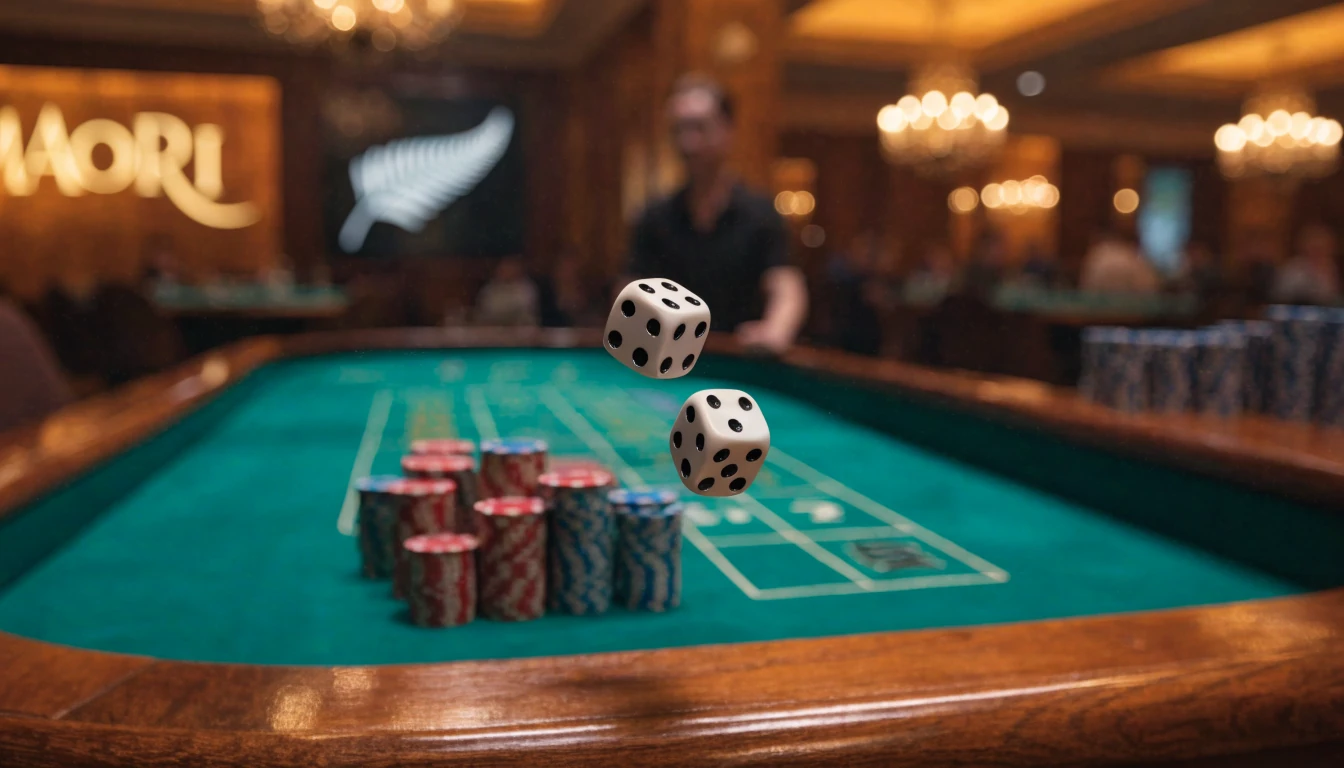
How Craps Works: Two Dice, One Roll at a Time
Craps is a dice game built around wagers on what two dice will show. You can bet on the result of a single roll or on an outcome that depends on a series of rolls. That distinction gives the game its central structure: some bets are settled immediately, while others remain in play as the shooter continues to roll.
The shooter is the person who rolls the dice. Players make their wagers before a roll, choosing which outcome they think will happen. The dice are rolled together, and their combined total determines what happens to the wagers according to the bet placed. In that sense, craps is not a game in which every player needs to roll; the shooter rolls, while the other players decide how to bet on the results.
A single total can matter in different ways depending on the wager. One bet may be decided by the next roll alone. Another may depend on a number appearing again before a different result ends the sequence. So the same roll can settle one player’s bet while leaving another player’s wager unresolved. Following the game means keeping track not only of the number rolled, but also of which bets are still active and what outcome each one needs.
Choosing a craps site in New Zealand means checking what is actually known about its licensing and payouts before you play. Use these operator notes as a starting point for your own checks.
-
BitStarz
- License
- Curaçao Gaming Authority, licence no. OGL/2024/165/0185
BitStarz lists a Curaçao Gaming Authority licence, number OGL/2024/165/0185. Check the licence details as part of your research before playing.
-
Wintino
- Payout speed
- 1-3 business days
Wintino states that payouts take 1–3 business days. This gives you a stated timeframe to consider when reviewing the site.
-
Ricky Casino
- License
- Tobique Gaming Commission, licence no. 0000002
Ricky Casino lists a Tobique Gaming Commission licence, number 0000002. You can use this licence information as a starting point for checking the operator.
-
7Bit Casino
- License
- Tobique Gaming Commission, licence no. 0000091
7Bit Casino lists a Tobique Gaming Commission licence, number 0000091. Check the licence details when assessing the operator.
-
Zotabet
- License
- 07017519840
- Payout speed
- 1-3 business days
Zotabet lists licence number 07017519840 and states a payout speed of 1–3 business days. These details offer two concrete points for your review.
-
N1 Casino
- License
- Malta Gaming Authority, licence no. MGA/B2C/394/2017
N1 Casino lists a Malta Gaming Authority licence, number MGA/B2C/394/2017. You can check that licence information as part of your assessment.
-
Neospin
- License
- Tobique Gaming Commission, licence no. 0000064
Neospin lists a Tobique Gaming Commission licence, number 0000064. Use the stated licence details as one point of reference before playing.
-
Lamabet
- Payout speed
- 1-3 business days
Lamabet states a payout speed of 1–3 business days. That gives you a stated timeframe to consider when reviewing the operator.
-
Play Grand
- License
- Malta Gaming Authority, licence no. MGA/B2C/370/2017
Play Grand lists a Malta Gaming Authority licence, number MGA/B2C/370/2017. You can check this licence information when assessing the operator.
This makes craps easier to understand as a set of wagers around a shared sequence, rather than as a contest to predict every roll. You are not required to forecast a long run of dice results to take part. A wager can concern the immediate outcome, or it can remain relevant across several rolls. The precise conditions depend on the bet, which is why the table’s rules matter as much as the dice themselves.
The two dice create a range of possible totals, but a total does not carry one universal meaning throughout the game. Its effect is tied to the stage of play and the wager being considered. A number that settles one bet may have a different role for another, and a roll can mark the start or continuation of a sequence. The basic idea remains simple: players stake money on what the dice will do, then the game resolves those stakes as the rolls unfold.
If you are new to craps, focus first on the relationship between a wager and the roll or sequence it depends on. The game’s terminology can make the layout seem more complicated than this core idea. Underneath it, craps is a shared dice game in which players choose outcomes to back, and two dice determine whether those choices succeed.

The Dice and the Come-Out Roll
A craps round begins with a roll called the come-out roll. Before the shooter throws the dice, players must place their bets. The shooter then rolls two dice, and their combined total determines which kind of opening result the table has seen.
A total of 7 or 11 is called a natural. The term describes the result of the come-out roll; it does not mean the dice have landed in a particular pattern. The two faces are added together, so different combinations can produce the same total.
A total of 2, 3 or 12 is called craps. These results are grouped under one name even though they are different totals. In this context, “craps” refers to the opening roll’s outcome, not to the game as a whole.
The other possible totals on the come-out roll are 4, 5, 6, 8, 9 and 10. When one of these appears, it is called the point. That changes the status of the round: the opening roll has established a number that remains relevant as play continues. The point is a total, not a single die face, and it can be made by more than one combination of the two dice.
These labels make it easier to follow craps without treating every roll as an isolated event. The come-out roll sorts the opening result into three categories: a natural, craps or a point. You can identify the category by adding the two dice, then checking which group contains the total.
Natural
A total of 7 or 11 on the come-out roll.
Craps
A total of 2, 3 or 12 on the come-out roll.
Point
A total of 4, 5, 6, 8, 9 or 10 on the come-out roll.
For instance, a combined total of 8 is a point, while a total of 11 is a natural. A total of 12 belongs to the craps category. The categories are specific to the opening roll; the same total can have a different role later in a round. That distinction matters because the come-out roll sets the initial state of play, rather than simply being another throw with no lasting effect.
Once the dice have been thrown, the table’s next step depends on which category the total falls into. For now, the key is to distinguish the names: natural means 7 or 11, craps means 2, 3 or 12, and the point is 4, 5, 6, 8, 9 or 10.
Pass Line and Don’t Pass: The Core Rules
Pass Line and Don’t Pass bets are opposing choices about how a round will resolve. You place one before the shooter rolls. The first roll, called the come-out roll, settles some bets immediately; otherwise, it establishes a point and the wager remains in play.
A Pass Line bet wins on a come-out roll of 7 or 11. It loses on 2, 3 or 12. A Don’t Pass bet reverses those results in part: it wins on 2 or 3 and loses on 7 or 11. A 12 is the exception. On that result, the Don’t Pass bet is returned as a push, so neither side wins or loses that wager.
If the come-out roll establishes a point, the round continues. For a Pass Line player, the aim is for that same point number to appear again before a 7. If it does, the bet wins. If a 7 appears first, the Pass Line bet loses.

Don’t Pass follows the opposite outcome after a point is set. It wins if 7 is rolled before the point, and loses if the point appears first. The order matters: the point and 7 are both possible outcomes on later rolls, but the first one to arrive decides the bet.
This structure is the core of craps gambling rules: the same wager can be settled on the opening roll or carry on until the point or 7 ends the decision. The come-out results are not interchangeable for the two bets, and the push on 12 applies specifically to Don’t Pass on that opening roll. Keeping those distinctions clear makes it easier to follow the round without confusing an immediate result with a point bet that is still active.
Craps Tables and the Come Bet
A craps table gives the game a shared, visible setting: players make wagers around the layout while one person, the shooter, rolls the dice. The layout is marked with betting areas, so the position of a wager matters. A Come bet is one of the bets you can add once the shooter has established a point. It is separate from the Pass Line wager already in play and follows the next roll.
A specialist review describes craps as being offered as a table game or live casino game on many casino sites serving New Zealand. That description is not a guarantee that a particular game is available to you. Remote interactive gambling is prohibited in New Zealand, and an unlicensed platform does not provide the same player protections as a regulated service. The table mechanics themselves are easier to follow if you focus on what happens to the Come bet after it is placed.
Once a point has been set, you can put a Come wager down before a roll. The next roll decides whether it settles immediately or moves to a number. A 7 or 11 wins for the Come bet; a 2, 3 or 12 loses it. If the roll is 4, 5, 6, 8, 9 or 10, the wager is moved from the Come area to the corresponding box number on the layout. That movement is why a Come bet is often described as working like a Pass Line bet after the opening roll, though it begins later in the round.
After it has moved, the Come bet remains associated with its box number. It wins if that same number is rolled again before a 7. If a 7 comes first, the bet loses. The shooter may make several rolls before either result occurs, so the wager can stay in place while the rest of the table continues to play. The box number is not a new choice made by the player after the roll; it is determined by the dice.
At the table, this sequence is useful to watch before placing a Come bet yourself. First identify that a point has already been established. Then note the next roll and whether the wager is paid, lost or transferred to a box number. Once transferred, track that number against 7. Keeping those stages distinct prevents a common confusion: the Come bet does not start by choosing a box number, but it can become tied to one through the next roll.
The layout makes that progression visible, but the bet still depends on the same two possible outcomes after it has moved: its assigned number, or 7. If you are following a live table, watch where the wager is placed after the roll and how the dealer handles it. That is enough to understand the Come bet’s role without treating every marked area as a separate rule.
Craps as a Casino Game: Where to Practise
Craps can appear in a casino’s game catalogue as a traditional table game or as a live casino title. A specialist review reports that both formats are offered on many casino sites aimed at New Zealand players. The wording matters: a catalogue entry tells you how a game is presented, not who operates the service or what protections apply to you.

At a physical table, the game takes place around a shared playing surface, with a shooter rolling the dice and other players placing wagers. In a live casino version, a dealer presents the game through a broadcast, while the interface lets you take part remotely. These formats give craps a different feel from a game in which every action and result is handled entirely by software. The live presentation is still a casino product, not a guarantee about the operator’s status.
If you want to learn the pace before risking money, a free demo can be a useful place to start. A specialist review describes demo versions as available for practising craps without wagering NZD. That lets you follow the sequence of play and see how the game responds to your choices without putting money at stake. Demo access may depend on the particular offering, so it is worth distinguishing a practice mode from a real-money table rather than assuming every version includes both.
A demo is most useful when you treat it as a way to understand the interface and follow the action, not as evidence that a real-money session will feel identical. Table layouts, controls and presentation can differ between versions. Practice can help you become familiar with where to find the game’s controls, but it cannot change the underlying outcomes or guarantee that you will be comfortable with every table.
The format also affects what you can observe. A table-game setting puts the shared action and dice at the centre; a live casino presentation adds a dealer’s handling of the game. Neither description, by itself, tells you whether a particular table is open at a given time or whether a free mode is available there. Those details belong to the individual offering, and the available formats can change.

There is an important New Zealand qualification. Remote interactive gambling is prohibited as a domestic offering, while New Zealanders may access offshore online casinos; that does not mean every provider is authorised to serve customers here. An unlicensed platform does not give you the same player protections as a regulated service. Before treating an online game as a place to practise, consider who is behind it and the protections that apply. A free mode avoids wagering NZD, but it does not turn an unlicensed platform into a licensed one.
Craps Online: Mobile Play and Live Dealers
Craps can be presented online in more than one format, but that does not mean every format is offered by every casino site. A specialist review reports that craps may be played on mobile devices in New Zealand. It also describes online games that may use live dealers. These are reports about possible formats, not a guarantee that a particular game or service is currently available to you.
Playing on a mobile device
A mobile version lets you access a game through a phone or tablet rather than sitting at a computer. The display may be arranged differently on a smaller screen, so the dice, table and betting controls can take up more of your attention. Before playing, it is worth checking that you can read the available information and select your choices clearly. If the controls are difficult to use, there is little advantage in trying to play at speed.
The underlying game remains craps: the digital presentation does not change what the dice represent or how a wager is resolved. What may differ is how the game is shown and controlled. An automated version presents the game through software, while a live-dealer format may show a real person conducting the game through a video stream. A specialist review reports that live-dealer craps may be available online in New Zealand, but that does not establish its availability on any particular site.
Mobile access also does not establish that a game is appropriate for every device, connection or situation. A screen can make it harder to keep track of the table and your decisions, especially if you are switching between the game and other activities. Take time to understand the interface before placing a wager, and walk away if you find yourself making choices without following what is happening.
- Ensure you can read all table information clearly on your screen.
- Verify that you can select your betting choices without difficulty.
- Confirm you are following the game action before placing a wager.
- Check that your connection is stable to avoid interrupted play.
Automated and live-dealer formats
In an automated game, the game action is generated and displayed digitally. This may be a useful distinction when comparing formats, but it says nothing by itself about the quality, fairness or terms of a particular service. Those depend on the provider and the game being offered; the label “automated” is not a substitute for checking what you are using.
A live-dealer game adds a streamed dealer to the online presentation. The dealer conducts the game on camera, while the player interacts through the digital interface. That can make the experience look more like a table game, but it is still remote interactive gambling, not a local casino table. The live format should not be taken as proof that a service is supervised or licensed in New Zealand.
Nor does a live image mean that every part of the game is visible to you. The camera view and controls are part of the provider’s presentation. You should be able to understand how to place a wager and what information is shown before deciding whether to continue. If the interface does not make those details clear, do not treat the presence of a dealer as reassurance.
Access is not the same as local authorisation
New Zealand’s rules distinguish between a person accessing an offshore website and a provider being permitted to offer online casino gambling in New Zealand. New Zealanders may play at offshore online casinos, but providers may not simply establish a domestic online casino or assume that they can offer iGaming products locally. Remote interactive gambling is prohibited in New Zealand as a locally provided service.
The Online Casino Gambling Act 2026 has introduced a domestic regulatory system, with transitional arrangements for providers that were already serving customers in New Zealand. That transition does not make every offshore site a locally authorised service. An unlicensed platform does not provide the same player protections as a service operating under the New Zealand regime. Before the new law, online casino gambling supplied from outside the country was not licensed or supervised by a New Zealand regulator, and customers wagering with those sites had no domestic government recourse.

So treat format claims and legal status as separate questions. A game described as mobile-friendly or live-dealer does not, on that basis, have New Zealand authorisation. Equally, a video stream or a polished interface cannot tell you what protections apply. The relevant issue is not only how the dice appear on screen, but who is providing the service and under what framework.
Online Craps and Bitcoin: Check What Is Actually Supported
A description of online craps does not establish that a site accepts Bitcoin. The game format and the payment methods are separate matters: a page may describe a craps game without saying how a customer can fund an account, and a reference to cryptocurrency does not show that it can be used for that game or by a person in New Zealand.
That distinction matters when comparing claims about Bitcoin craps. “Available online” might describe a digital game, while “live dealer” refers to a game presented with a human dealer. Neither phrase, on its own, answers whether Bitcoin is accepted. Nor does the presence of a Bitcoin logo or a general cryptocurrency payment page establish that a particular craps game is accessible through that payment route.
A specialist review has described online craps in New Zealand as playable on mobile devices and as potentially available with live dealers. Those descriptions concern how the game may be presented, not which payment options a site supports. A phone or tablet can display a game, but the device does not determine whether a payment method is accepted. Likewise, a live dealer is not evidence of a crypto facility.
Separate the game from the payment claim
When a site makes a claim about Bitcoin, the useful detail is not merely whether the word appears. You would need to know what the claim applies to: the operator generally, a particular account function, or a specific craps product. Those are not interchangeable. A broad statement about cryptocurrency may not show that it applies to all games, and a game listing may say nothing about cryptocurrency at all.
The same care applies to phrases such as “real online craps.” They can describe a game played for money rather than a free demonstration, but they do not identify the payment method or establish that Bitcoin is accepted. They also say nothing by themselves about whether a provider may lawfully offer remote interactive gambling to customers in New Zealand.
Kiwi laws set a separate boundary. Remote interactive gambling is prohibited in New Zealand, and the Online Casino Gambling Act 2026 provides the framework for a domestic licensing regime. The transition allows operators that were already serving people in New Zealand before the Act came into force to continue until 1 December 2026. That is a limited transitional arrangement, not a general assurance that any offshore service may offer its products in New Zealand. New Zealanders may play at offshore online casinos, but providers may not offer iGaming products in New Zealand outside the applicable legal route.
This legal distinction is independent of payment technology. Bitcoin acceptance, if a provider claims it, would not make an otherwise unavailable service lawful. Equally, a site’s description of a craps game does not establish that the provider has authority to offer remote interactive gambling in New Zealand. A payment choice cannot substitute for the relevant regulatory status.
Read payment claims narrowly
Treat claims about Bitcoin as claims that need to be read in context, rather than as proof that “Bitcoin craps” is a single, confirmed product. Check whether the wording actually names craps, whether it refers to a payment method or only to a general account feature, and whether it is directed at customers in New Zealand. A mention on a promotional page may be less specific than a clear statement in the terms governing the payment function.
The reverse is also true: a site that describes mobile play or a live dealer has not thereby made a statement about cryptocurrency. Those features answer different questions. If a page does not say that Bitcoin can be used, do not infer acceptance from the game’s availability, the device you use, or the presence of a live stream.
Do not treat a search result, logo, or short promotional phrase as a substitute for the full wording. The exact scope of a payment claim matters, particularly where it is unclear whether it applies to the relevant game or to customers in this market. Avoid relying on a broad label when the practical question is specific: whether the stated payment option applies to the particular service being described.
The careful conclusion is limited: online craps may be described in mobile or live-dealer formats, but those descriptions do not establish Bitcoin support. Keep game access, payment claims, and the provider’s legal position distinct. A claim about one does not settle the others.
Craps Betting Strategy: Odds and Place Bets
A useful way to assess a craps betting strategy is to separate what a wager predicts from what it costs. Place bets and Odds bets both depend on numbers being rolled before a 7, but they attach to different parts of play.
A Place bet is a wager that one chosen box number—4, 5, 6, 8, 9 or 10—will appear before a 7. You are backing that number directly, rather than relying on the point to return. The wager loses if 7 arrives first. The numbers covered are the same whether you choose one or several; adding more numbers changes what you are betting on, not the basic condition for each Place bet.
An Odds bet works differently. It pays if the point is rolled again before a 7. It can be added to a Pass bet, and the amount placed as Odds is restricted relative to the Pass bet. That limit matters: Odds are not a separate route around the table’s rules, and the available amount depends on the underlying Pass wager.
The distinction worth noting is the house edge. Odds bets have no house edge, while that does not mean they are risk-free or that they guarantee a return. The point may not arrive before a 7, and the wager can lose. Nor does the absence of a house edge on the Odds portion erase the cost attached to other bets in the round.
Place bets and Odds bets therefore should not be treated as interchangeable tools. A Place bet backs a selected box number before a 7; an Odds bet backs the established point before a 7. Before choosing either, identify exactly which number must arrive and what event ends the wager unsuccessfully. That is more informative than calling a betting pattern a system: changing the arrangement of wagers does not alter the outcomes each bet requires.
Craps Betting Systems and the Cost of a Come Bet
A betting system can change how you size or sequence wagers, but it does not change the terms of a Come bet. One concrete point to weigh is its house edge: a specialist review estimates that the Come bet carries an edge of about 1.4% when no Odds bet is added. That figure is an estimate, not a promise about what any individual session will cost.
The house edge is a long-run measure of the game’s built-in advantage, not a fee deducted from each wager. In a short session, results can vary, and you may win or lose more than the estimate suggests. Over repeated play, however, the edge is relevant when comparing betting approaches: changing the order or size of Come bets does not remove the underlying disadvantage.
This matters when a system relies on increasing a wager after a loss or stepping it down after a win. Such a pattern may alter the amounts at risk from roll to roll, but it cannot make a losing outcome pay as a winning one. Nor does a run of results determine what the next roll will be. A system’s record of recent wins and losses is therefore not a reliable guide to the next result.
Before using any staking pattern, consider how it interacts with the Come bet’s cost and decide what you are prepared to lose. A larger wager exposes more money to the same underlying bet conditions; it does not improve them. If a plan depends on recovering earlier losses, it can also require continued play precisely when you may prefer to walk away.
A useful test is whether the system still makes sense if the next result goes against you. If its logic depends on a win arriving soon, it is not a way around the house edge. Treat the estimated 1.4% as a reason to assess the wager carefully, not as a forecast of your personal result or a target that a betting sequence can reliably beat.
New Zealand’s Online Casino Rules During 2026
New Zealand’s rules distinguish between a person using an offshore casino and a provider offering online casino gambling to customers in New Zealand. New Zealanders may play at offshore sites, but that does not mean an offshore provider is permitted to operate here. The restriction is on providing the service in New Zealand, rather than on the player placing a wager. Remote interactive gambling is therefore not a generally authorised domestic service.
The Gambling Act 2003 has governed gambling activities, but it did not permit online casinos to be based in New Zealand. Before the new regime, online casino services supplied from offshore were not licensed or supervised by a New Zealand regulator. A customer who wagered with an offshore site during that period had no domestic government recourse. That is a material distinction from having protections under a New Zealand licensing system.
The Online Casino Gambling Act 2026 came into force on 1 May 2026, establishing the country’s first domestic licensing framework for online casino gambling. Its introduction is staged rather than immediate: the transition allows certain existing providers to continue temporarily while the new system is put in place. The Department of Internal Affairs is leading that implementation, and the full licensed regime is not expected to be operational until 2027.
What changes during the transition
An online casino that was already serving people in New Zealand before 1 May 2026 may continue operating during the transition, but only until 1 December 2026. That temporary permission does not amount to a permanent licence or mean that every offshore site qualifies to remain.
From 1 December 2026, providing online casino gambling to customers in New Zealand is limited to operators that succeed in the auction process and are entitled to apply for a licence. Operators without that route must leave the market by the deadline. A provider’s previous presence, or a player’s ability to reach its website, does not by itself establish that the provider can continue offering the service.
Licences are expected to begin being issued from early 2027, with the wider regulatory system phased in over that year. The dates describe a transition, not a single moment when every part of the licensing system is complete. The Department of Internal Affairs’ role in implementing the regime also makes it the relevant government body for understanding how the new system is introduced.
For someone considering craps gambling at an offshore casino, the practical point is that access and provider permission are separate questions. New Zealanders may use offshore casinos, but that does not give those operators permission to provide iGaming products in New Zealand. Nor does access mean the same player protections apply as under a domestic licence. During the transition, the rules depend on when the provider began serving New Zealand customers and whether it has the qualifying route to apply for a licence; after 1 December 2026, only operators meeting the auction and application requirements may provide the service. The transition is specific, not an open invitation to every offshore platform.
Casino Games in New Zealand: Rules and Options
Content created by the «casinotipsnz.com» team